Generate a State Machine Diagram From Code
Generate a state machine diagram from TypeScript, Python or PHP code, then find every invalid state transition in it, cited to the line that allows it.

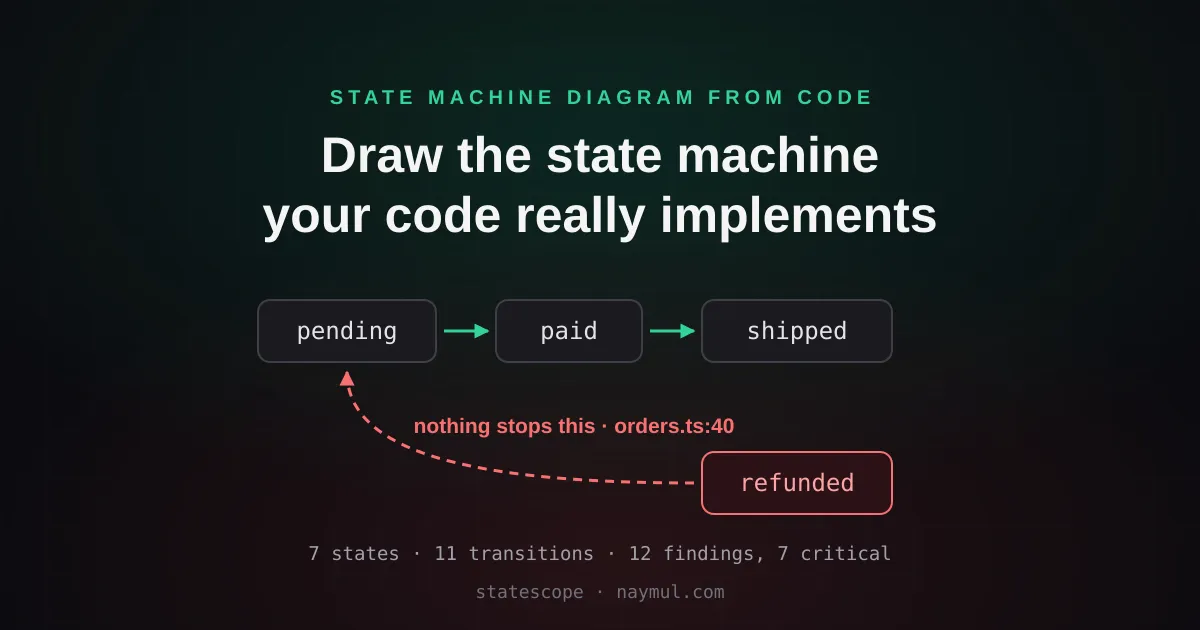
Ask a coding agent for an order flow and you get an enum in about four seconds, then a handler for every button. markPaid checks that the order is pending, which is correct. ship checks that it is paid, also correct. Then support wants a retry button, the warehouse wants to "unship" a parcel with the wrong label, and the admin panel needs a setOrderStatus(id, status) that writes whatever it is given.
Every one of those functions is correct when you read it on its own. Together they implement a state machine nobody designed: refunded can go back to pending, shipped can go back to paid, and five separate writes can move an order into a new state from any state at all. Nobody can see that by reading the code, because the machine is not written down anywhere. It only exists as the sum of every line that assigns status.
The short answer: to generate a state machine diagram from code, you have to recover the machine before you can draw it. The states come from the enum, union or CHECK constraint you already declared. The transitions come from the code: every read of the status field that guards a write to it is an edge, and every write that nothing guards is an edge from any state. statescope, an open-source tool I wrote, does this for TypeScript, JavaScript, Python, PHP, Prisma and SQL. Its render.py --mermaid prints a Mermaid stateDiagram-v2 that GitHub renders natively, and audit.py lists every invalid state transition with the file and line that allows it.
This post runs it on four files an agent could write in an afternoon. They produce the diagram below and 12 findings, 7 of them critical. Then it shows how to fix each kind of invalid transition, in Prisma and in plain SQL, so the next diagram comes back clean.
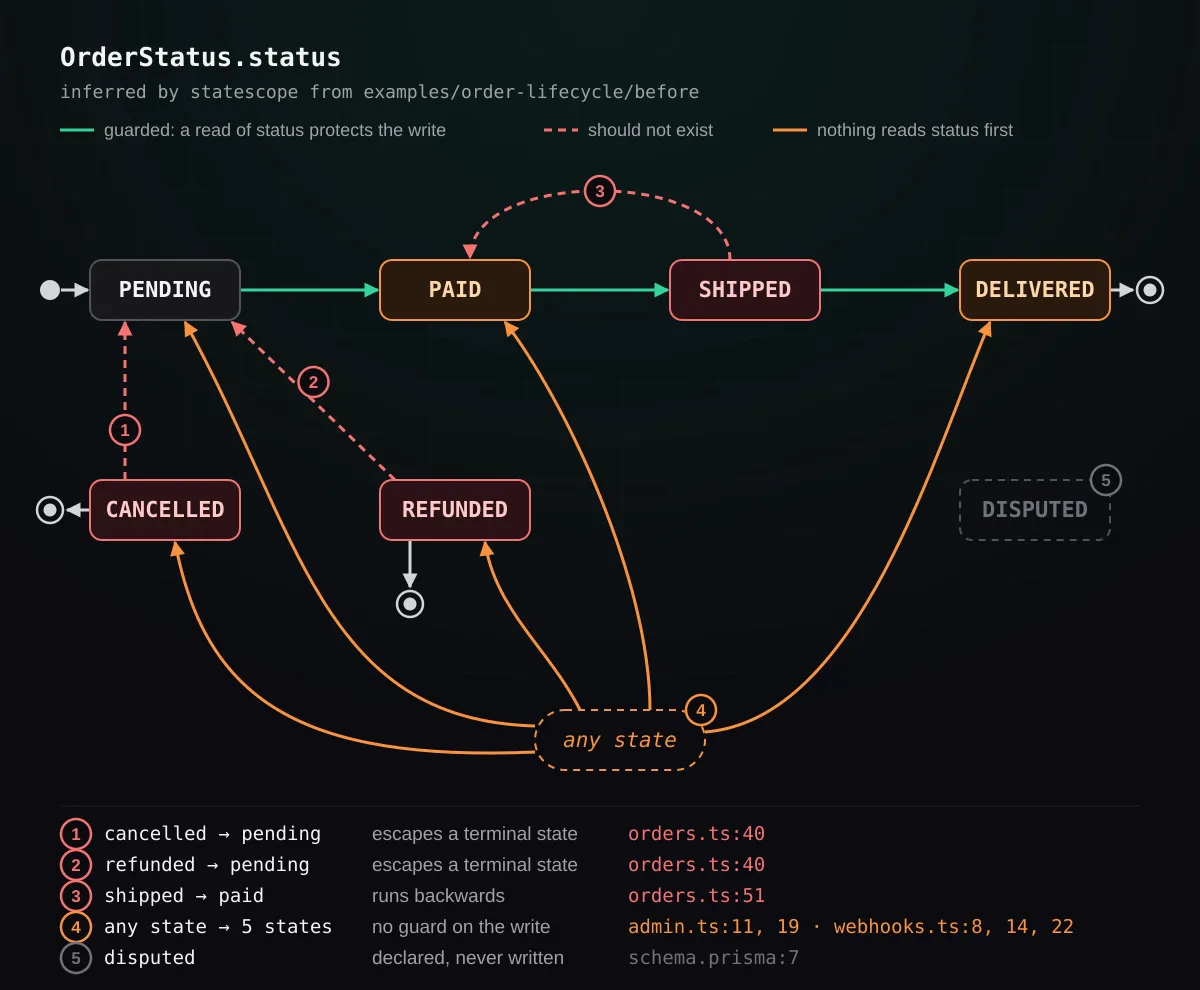
The machine statescope recovered from the example's four files. Every arrow is an edge in its output. Green is guarded by a read of status, red should not exist, and orange is reachable from any state because nothing reads status first.
What is an implicit state machine?
An implicit state machine is a lifecycle that no single piece of code defines. There is no transition table, no canTransition() function and no diagram anyone keeps current. The machine is the combined effect of every place that writes a status column, and its transitions are whatever those writes happen to allow.
Most applications have several: orders, subscriptions, invoices, support tickets, background jobs, KYC checks, moderation queues. Each one starts with an enum that looks like a design:
enum OrderStatus {
  PENDING
  PAID
  SHIPPED
  DELIVERED
  CANCELLED
  REFUNDED
  DISPUTED
}
The enum constrains the values the column can hold. It says nothing about the order in which they can be reached. A CHECK (status IN (...)) constraint stops a typo at the database and has no opinion on whether refunded → pending should be possible. So the lifecycle in the team's heads (pending, paid, shipped, delivered, with cancelled and refunded off to the side) and the one the code implements drift apart a handler at a time.
Why do coding agents write invalid state transitions?
Because an agent writes one handler at a time, and a state machine is a property of all of them together. A schema gets reviewed as one artifact. A lifecycle never does. The defects that follow are consistent enough to name:
- Each handler guards only the case in front of it.
shipchecks forpaidbecause the agent was asked to writeship. The functions written in other sessions had no reason to check anything. - Convenience endpoints have no lifecycle. A retry, a reset, an admin override: each one was written to close a single support ticket and stays in the code for good.
- Webhooks write whatever the event implies. Stripe's webhook documentation says "Stripe doesn't guarantee the delivery of events in the order that they're generated", and warns that an endpoint can receive the same event more than once. A
charge.succeededthat arrives aftercharge.refunded, written with no guard, moves a refunded order back topaid. - The read and the write are two round trips.
findUnique, thenupdate, is a lost-update race the first time a webhook retries or a customer double-clicks.
None of this fails code review, because each function looks fine in its own diff. It is also the category where AI-written code measurably does worse. CodeRabbit's December 2025 analysis of 470 open-source pull requests found logic and correctness problems 75% more often in pull requests co-authored by AI than in human-only ones. It is a vendor's study, and its authors say they could not confirm authorship for every pull request, but the direction is hard to miss.
How to generate a state machine diagram from code
statescope needs Python 3.9 or newer and nothing else. There are no packages to install, no config file and no database connection.
Step 1: Install statescope
If you use a coding agent (Claude Code, Cursor, Codex, OpenClaw, or anything else that reads a SKILL.md), paste this to it:
Install statescope for me by reading
https://raw.githubusercontent.com/NHTanvir/statescope/master/llms.txt
Or clone it yourself:
git clone https://github.com/NHTanvir/statescope ~/.claude/skills/statescope
Claude Code can also add it as a plugin with /plugin marketplace add NHTanvir/statescope. Once it is installed you don't have to name it: asking your agent to draw the order lifecycle, or why an order is in an impossible state, is enough.
Step 2: Run it on your code
From the root of your project:
python3 ~/.claude/skills/statescope/scripts/render.py . --mermaid
It reads every .ts, .tsx, .js, .jsx, .mjs, .cjs, .py, .php, .prisma and .sql file, skips node_modules, vendor, dist, build and other generated or dotted directories, and prints one diagram per state machine it finds. If there are several, --machine=NAME draws just one.
Step 3: Paste the Mermaid where people will see it
For the example, the output is this, with the state labels and colour classes trimmed:
stateDiagram-v2
    direction LR
    [*] --> pending
    state "any state" as any_state
    any_state --> cancelled : unguarded · admin.ts L11
    any_state --> delivered : unguarded · webhooks.ts L22
    any_state --> paid : unguarded · webhooks.ts L14
    any_state --> pending : unguarded · admin.ts L19
    any_state --> refunded : unguarded · webhooks.ts L8
    cancelled --> pending : escapes cancelled · orders.ts L40
    paid --> shipped : orders.ts L19
    pending --> paid : orders.ts L9
    refunded --> pending : escapes refunded · orders.ts L40
    shipped --> delivered : orders.ts L29
    shipped --> paid : backwards · orders.ts L51
    delivered --> [*]
    cancelled --> [*]
    refunded --> [*]
Put it in a fenced code block marked mermaid and GitHub draws it in a README, an issue, a pull request, a discussion or a wiki page. Because it is generated from the code, it can't drift the way a hand-drawn diagram does when someone forgets to move a box.
Two details keep the diagram honest:
- Every edge carries the file and line that allows it, so any arrow you doubt takes one click to check.
any stateis not a state. It is what an unguarded write means: if nothing reads the status before writing it, every state can reach the target, terminal ones included. One node shows all five of those writes without drawing an arrow from every state.
For a person rather than a repository, render.py . --out=state-review.html writes a single HTML file with the diagram, every finding and the fix for each, in light and dark themes.
How statescope finds the transitions
This is the part worth understanding, because it is what makes the diagram checkable rather than a guess.
A guarded transition is a read of the state field that dominates a write of it:
const order = await prisma.order.findUnique({ where: { id: orderId } });
if (order.status === "paid") {                 // read,  line 16
  await prisma.order.update({
    where: { id: orderId },
    data: { status: "shipped" },               // write, line 19
  });
}
That is the edge paid → shipped, and the finding carries both line numbers. A guard on the far side of a function boundary doesn't count, and nothing inside a comment is ever evidence.
A write with no such read is reported as * → shipped. It is less an edge than an admission: if nothing reads the state first, every state reaches that one.
If your codebase already keeps a transition table, one ALLOWED map in one place, statescope reads that instead and marks the edges declared. That is the state a project should be in, and the audit says so by going quiet.
The state set comes from whatever you already declared:
| Source | Looks like |
|---|---|
| Prisma enum | enum OrderStatus { PENDING PAID } |
| TypeScript union | type JobState = 'queued' | 'running' |
| TypeScript enum | enum Status { Draft = 'draft' } |
as const array | const STATES = ['open','closed'] as const |
Python Enum | class TicketStatus(str, Enum) |
| PHP 8.1 enum | enum InvoiceStatus: string { case Draft = 'draft'; } |
SQL CHECK | CHECK (status IN ('pending','paid')) |
| MySQL / Postgres enum | ENUM('a','b'), CREATE TYPE … AS ENUM |
An enum that is not a lifecycle, such as Currency, Role or Locale, is skipped. A set qualifies on its field name or its members, never just for being an enum.
It also reads Prisma ORM 8, where the schema file is contract.prisma and a filtered write is .where(...).updateAndCount(...). A state inside .where({ id, status: "paid" }) counts as the guard, so .where({ id, status: "paid" }).updateAndCount({ status: "shipped" }) is the edge paid → shipped.
Reading the audit
Run on the example that ships with the repository:
cd ~/.claude/skills/statescope
python3 scripts/audit.py examples/order-lifecycle/before
  STATE AUDIT   examples/order-lifecycle/before
  1 machine · 7 states · 11 transitions · 4 files

  OrderStatus.status  (prisma_enum, schema.prisma:7)

  critical    7  ████████████████████████
  high        2  ███████
  medium      2  ███████
  low         1  ████

  12 findings across 1 machine
Then the findings, worst first, each one citing the line that allows it:
  OrderStatus · refunded -> pending
    refunded -> pending is reachable. refunded is a terminal state.
    terminal_state_escape — refunded is where a thing stops. Code downstream
    of it assumes it is settled: refunds are reconciled, invoices are closed,
    the warehouse has stopped caring. Moving it back to pending re-opens all
    of that with no record that it happened, and every report that already
    counted it is now wrong in a way nothing will flag.
      src/orders.ts:40 (guard at :37)  data: { status: "pending" },
Other shapes, when a terminal isn't where the result is going:
python3 scripts/audit.py . --markdown   # a table for a pull request comment
python3 scripts/audit.py . --json       # for your own tooling
python3 scripts/audit.py . --strict     # exit 1 on any critical, for CI
python3 scripts/extract.py .            # just the inferred machine, as JSON
The five invalid state transitions to fix first
1. A terminal state that can be escaped
refunded, cancelled, completed, delivered: these are promises to the rest of the system. Accounting has reconciled the refund. The warehouse has closed the pick. The customer got the email.
In the example, a retry button for support breaks two of those promises at once:
// Support asked for a "retry" button. Nobody asked what it should refuse.
export async function retryOrder(orderId: string) {
  const order = await prisma.order.findUnique({ where: { id: orderId } });
  if (order.status === "refunded" || order.status === "cancelled") {
    await prisma.order.update({
      where: { id: orderId },
      data: { status: "pending" },
    });
  }
}
Moving the row back out re-opens everything downstream with no record that it happened, and every report that already counted it is now wrong in a way nothing will flag. The row looks completely ordinary afterwards, which is what makes it expensive. If the reversal is deliberate, it is a different state, reopened rather than pending, so reports can tell a fresh order from a resurrected one.
2. A write that no read protects
The most common defect in generated state code. The example has five, and the one in the payment webhook is typical:
// Stripe calls this. It trusts the event and writes whatever it implies.
if (event.type === "charge.succeeded") {
  await prisma.order.update({
    where: { id: event.orderId },
    data: { status: "paid" },
  });
}
Nothing compares the current status first, so every state reaches paid, including refunded, cancelled and delivered. With webhooks delivered out of order, that is not hypothetical. The real machine is fully connected, and the diagram in your head is fiction.
3. A write that accepts any value
Worse, because the set of reachable states stops being the enum at all:
// The admin tool. One form field, one write, no questions asked.
export async function setOrderStatus(orderId: string, status: string) {
  await prisma.order.update({ where: { id: orderId }, data: { status } });
}
The enum constrains the column, and the caller decides what goes in it. This is the write that puts a state into production that your own diagram does not contain. statescope drops the finding as soon as a validation dominates the write, whether that is ALLOWED[from].includes(to), z.enum(...), Object.values(OrderStatus).includes(...) or a canTransition() call.
4. A read-then-write race
const order = await prisma.order.findUnique({ where: { id } }); // reads "paid"
if (order.status === "paid") {
  await prisma.order.update({ where: { id }, data: { status: "shipped" } });
}
Two round trips. Between them the row can move, so two callers that both read paid will both write, and the second one wins silently. Webhook retries and double-clicked buttons do exactly this, which is why the bug report arrives on your busiest day.
The fix is to put the expected state in the WHERE clause so the database refuses the second write:
const { count } = await prisma.order.updateMany({
  where: { id, status: "paid" },          // not just { id }
  data: { status: "shipped" },
});
if (count === 0) throw new ConcurrentTransition(id);
This works because of how the database settles the collision. Under PostgreSQL's default Read Committed isolation, an UPDATE that finds its row already changed by a concurrent transaction waits for that transaction to commit, then re-checks its WHERE clause against the new version of the row. The loser no longer matches status = 'paid', updates zero rows, and is told so. A row lock (SELECT … FOR UPDATE) or a version column also works.
5. A transition that runs backwards
shipped → paid after the label has printed. Side effects don't reverse when the column does: the email went out, the webhook fired, the stock moved. Reversing the state tells the system none of that happened.
statescope only calls an edge backwards when it ranks both lifecycle words, so unfamiliar vocabulary produces silence rather than a guess.
The other eight rules cover dead states, unreachable states, states nothing ever reads, a lifecycle with no end, writes that go around your own transition helper, a missing transition history, duplicate guards and bare string literals. Each is documented with its reasoning and its failure cases in references/audit-rules.md.
How to prevent invalid state transitions
To prevent invalid state transitions, put the whole machine in one table, and make every write go through one function that checks the table and carries the expected state in its WHERE clause. That is the entire fix. Everything else is detail.
A Prisma state machine in one table
This is the after version of the example, lightly trimmed. The table is the only thing that defines the machine:
const ALLOWED: Record<OrderStatus, OrderStatus[]> = {
  PENDING: [OrderStatus.PAID, OrderStatus.CANCELLED],
  PAID: [OrderStatus.SHIPPED, OrderStatus.REFUNDED],
  SHIPPED: [OrderStatus.DELIVERED],
  DELIVERED: [],
  CANCELLED: [],
  REFUNDED: [],
};

export async function transition(
  orderId: string,
  from: OrderStatus,
  to: OrderStatus,
  actorId: string | null,
  reason?: string,
): Promise<void> {
  if (!ALLOWED[from].includes(to)) {
    throw new IllegalTransition(`${from} -> ${to} is not a legal move`);
  }

  await prisma.$transaction(async (tx) => {
    const { count } = await tx.order.updateMany({
      where: { id: orderId, status: from },
      data: { status: to, statusChangedAt: new Date() },
    });
    if (count === 0) {
      throw new ConcurrentTransition(`${orderId} was not in ${from} when the move was attempted`);
    }
    await tx.orderStatusHistory.create({ data: { orderId, from, to, actorId, reason } });
  });
}
Three things are doing the work. The table turns an illegal move into a thrown error instead of a silent write. The where turns a race into a refused update instead of a corrupted row. The history insert, in the same transaction, records who made the move and why. Each caller becomes one line: transition(orderId, OrderStatus.PAID, OrderStatus.SHIPPED, actorId).
On Prisma ORM 8 the guarded write is db.orm.public.Order.where({ id: orderId, status: from }).updateAndCount({ status: to }), which returns the number of rows changed rather than { count }. Prisma's client reference lists updateAndCount() as the new name for updateMany.
Every finding statescope prints also comes with a starting table generated from the states it found, in the language the machine was declared in: TypeScript, Python, PHP, or SQL with a trigger. Treat it as a draft. Which moves are legal is a product decision, and the tool won't apply it for you.
The same guard in plain SQL
An if in one language protects one codebase. Jobs, migrations, admin consoles and the psql session someone opens at midnight all bypass it. The WHERE clause protects all of them:
UPDATE "order" SET status = 'shipped', status_changed_at = now()
 WHERE id = $1 AND status = 'paid';
-- 0 rows updated means someone else moved it first. That is information.
Store the move, not just the position
The status column tells you where a row is. It can't tell you how it got there, and that is the question every support ticket asks. An append-only history table answers it for the cost of one insert per move. This is the one statescope suggests:
CREATE TABLE status_history (
  id bigserial PRIMARY KEY,
  order_id text NOT NULL REFERENCES "order" (id),
  from_status text,
  to_status   text NOT NULL,
  actor_id text,
  reason   text,
  at timestamptz NOT NULL DEFAULT now()
);
From 12 findings to zero
The repository ships the whole thing as a worked example. examples/order-lifecycle/before is four files and ten status writes, which is what an afternoon of ordinary agent output looks like. It audits to 12 findings, 7 of them critical: a terminal state escaped two ways, a transition that runs backwards, five writes with no guard, an admin endpoint that accepts any string, read-then-write races, a dead state and no history.
after is the same model behind one transition table. It audits to 0 findings with 5 declared transitions, and the whole verdict is one line:
No findings. Every path in this machine is one you declared.
The states barely change between the two directories. DISPUTED, which nothing ever wrote, is gone. What changes is that the second one says, in one place, what is allowed.
Failing CI on an invalid transition
An audit you have to remember to run stops happening in week three. --strict exits with status 1 on any critical finding, so one workflow step catches the next unguarded status write before it merges:
# .github/workflows/statescope.yml
name: statescope
on: [pull_request]

jobs:
  audit:
    runs-on: ubuntu-latest
    steps:
      - uses: actions/checkout@v4
      - run: git clone --depth 1 https://github.com/NHTanvir/statescope /tmp/statescope
      - run: python3 /tmp/statescope/scripts/audit.py . --strict
On the example, before exits 1 and after exits 0.
How does statescope compare with XState, Mermaid and AI diagram tools?
Most state machine tools draw or run a machine that someone has already written down. statescope recovers the one your code implements, whether or not anyone did.
| Tool | You give it | Infers the machine from existing code | Cites the line behind each invalid path | Same result every run |
|---|---|---|---|---|
| statescope | your repository | Yes | Yes | Yes |
| XState and Stately's visualizer | a machine you write as XState config | No | No | Yes |
| state-machine-cat | a chart you write in its DSL | No | No | Yes |
| Mermaid or PlantUML by hand | a diagram you type | No | No | Yes |
| AI diagram generators | a prompt or a pasted snippet | Only from the snippet | No | No |
| An LLM reviewing the code | your code, in a prompt | Partly | Unverified | No |
XState is the better choice when you are designing a new machine. statescope is for the one you already shipped. They work well together: recover the machine with statescope, decide which edges should exist, then move it into XState or a transition table.
What a static state machine audit cannot see
statescope reads source text, so it has the limits every static tool has, and it says so rather than hiding them:
- A guard it doesn't recognise shows up as
* → state, which overstates the problem. Every edge carries its line, so one click settles it. - Dynamic dispatch, reflection and states assembled from string fragments are invisible to it.
- Backwards transitions are only reported for lifecycle words it ranks, so
backwards_transitionstays quiet on vocabulary it doesn't know. - Only the file types listed above are read. Ruby, Go, Java and C# code is not scanned.
- A finding is a judgement, not a fact.
backwards_transitionon a deliberate re-open flow is correct behaviour with a misleading name.
Questions people ask
How do I generate a state machine diagram from code?
Recover the machine first, then draw it. The states come from your enum, union or CHECK constraint, and the transitions from every read of the status field that guards a write to it. statescope does both: run python3 ~/.claude/skills/statescope/scripts/render.py . --mermaid in your project and paste the output into any Markdown file that GitHub renders.
What is an invalid state transition?
A move between two states that the business never meant to allow, such as refunded → pending or shipped → paid. Most codebases don't forbid them anywhere. An enum limits which values a status column can hold, not the order they arrive in, so any write that skips the check creates one.
How do you prevent invalid state transitions?
Keep the allowed moves in one table, send every status write through one function that checks it, and put the expected current state in the update's WHERE clause so the database refuses a write that lost a race. An append-only history table then records who made each move and why.
How do you implement a state machine in a database?
Store the current state in one column limited to known values, keep the allowed moves in a transition table (in code, or enforced by a trigger), update with WHERE id = $1 AND status = $2, and log every move to an append-only history table. The column says where a row is, and the history says how it got there.
Is there a state machine library for Prisma?
You rarely need one. A Record<Status, Status[]> table and one transition() function that calls updateMany({ where: { id, status: from } }) and checks the returned count is a complete Prisma state machine. On Prisma ORM 8 the call is .where(...).updateAndCount(...). statescope prints a starting table built from your enum.
What is the difference between a state diagram and a state machine?
A state machine is the behaviour: the states and the moves allowed between them. A state diagram is a picture of one. In most codebases the two disagree, because the diagram was drawn from intent while the machine is whatever the code allows. Generating the diagram from the code closes that gap.
Should a status field be an enum or a state machine?
Both. The enum, union or CHECK constraint fixes which states exist, and a transition table fixes which moves between them are legal. An enum alone isn't a state machine, because it lets every state follow every other one.
Does GitHub render Mermaid state diagrams?
Yes. Put the stateDiagram-v2 source in a fenced code block marked mermaid, and GitHub draws it in Markdown files, issues, pull requests, discussions and wikis. Add direction LR for a left-to-right layout, which suits a pipeline like an order lifecycle.
Which languages does statescope support?
It reads TypeScript, JavaScript, Python and PHP, plus Prisma schemas (including Prisma ORM 8's contract.prisma) and SQL. States come from Prisma enums, TypeScript unions and enums, as const arrays, Python Enum, PHP 8.1 enums, SQL CHECK constraints and MySQL or PostgreSQL enums. Ruby, Go and Java files are not scanned.
Does statescope run my application or send my code anywhere?
No. It reads source files with plain Python and the standard library. There's no connection string, no instrumentation and no traffic, and the scripts make no network calls. The optional HTML report loads the Mermaid library from a CDN when you open it, but nothing from your code is sent.
How is statescope different from XState?
XState runs a machine you write down as an XState config, and Stately's tools draw it. statescope is for the more common case where nobody wrote the machine down. It recovers the one your code already implements, so you can see it and argue with it, and then move it into XState or a transition table.
Will statescope rewrite my code?
No, deliberately. Which transitions are legal is a product decision: a table that forbids delivered → shipped is right for most shops and wrong for one that reships lost parcels. It prints the table and you decide.
Related
If you are auditing the schema that declares the enum in the first place, schemascope is the same idea one layer down: ranked findings on a database schema, each with the DDL that fixes it.
If the question is who is allowed to trigger those transitions, gatescope maps every API route to the guards that actually protect it, and names the routes that nothing is guarding.
I have also written up three tools for MCP servers: Statelint for the stateless 2026-07-28 revision, Hookbench for MCP Events, and Pollen for poppy.json.
Get it
github.com/NHTanvir/statescope: MIT licensed, no dependencies, 76 tests.
If you find an invalid transition it should have flagged and didn't, that is the most useful contribution there is. Open an issue with the smallest snippet that reproduces it, and it becomes a rule.