Stateless MCP (2026-07-28): How to Migrate
What stateless MCP (2026-07-28) changed, why servers must reject Mcp-Method and Mcp-Name header mismatches with -32020, and how to migrate and test.

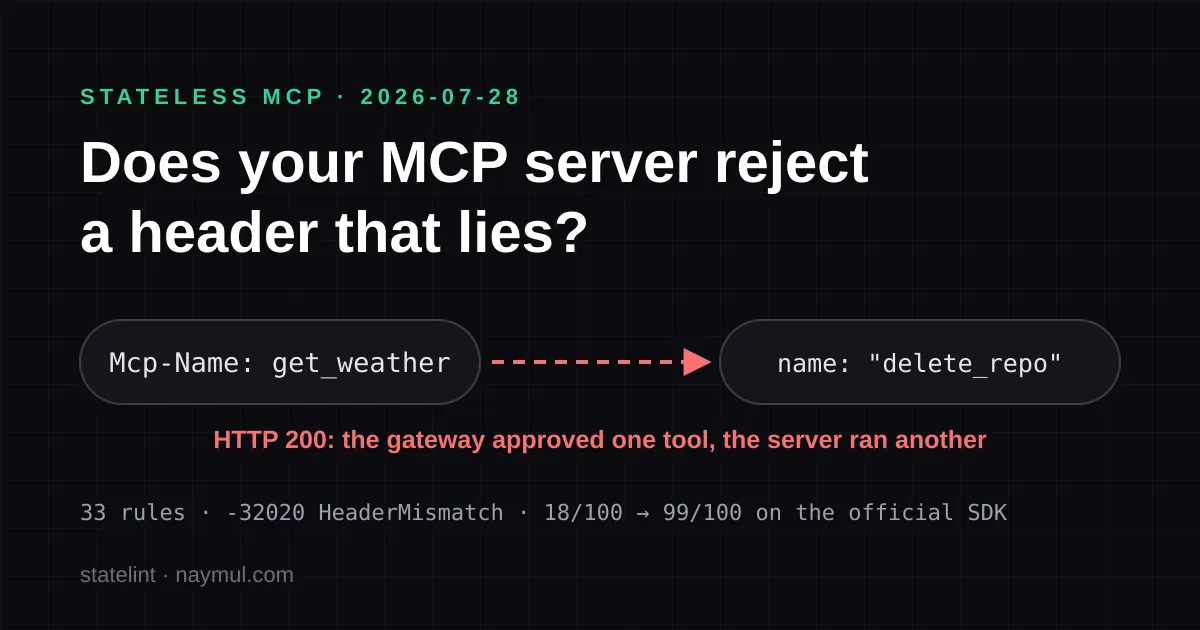
On July 28, 2026, the Model Context Protocol stopped being a stateful protocol. The initialize handshake is gone, the Mcp-Session-Id header is gone, and every Streamable HTTP request now repeats its method and target in HTTP headers so that load balancers and gateways can route it without reading the body. That last change comes with a rule most write-ups skip: a server must reject any request whose headers disagree with its body.
I wanted to know how far a typical server is from that. So I built three small servers on the official TypeScript SDK and graded each against the 2026-07-28 spec. The sessionful server from the SDK's v1 README scored 18 out of 100. The same SDK's v1 "stateless mode", which many tutorials present as the stateless option, also scored 18: it rejects protocol version 2026-07-28 outright. A server on the v2 SDK's createMcpHandler scored 99. Then I ran the official upgrade codemod plus one more tool on the README server, and it went from 18 to 99 without me touching the code.
The short answer: stateless MCP is the 2026-07-28 revision of the Model Context Protocol, in which "all the information needed to process a request is contained in the request itself." There is no initialize and no session. Every request carries its protocol version and client capabilities in _meta, and every HTTP POST carries MCP-Protocol-Version, Mcp-Method and, for named targets, Mcp-Name headers that the server must check against the body, answering 400 with error -32020 when they disagree. To check a server, run npx github:NHTanvir/statelint check <your-mcp-url>.
That command is Statelint, an open-source conformance linter and migration tool I wrote for this revision. It sends at most 28 safe requests, grades the server on 33 rules taken from the spec text, and prints a 0-100 score with a fix for every failure. Its migrate command reads a 2025-era server's code and rewrites the entry point to the new stateless one when it can prove the rewrite safe. It has no runtime dependencies and also ships as a GitHub Action. This post covers what changed, why the header rule matters, how to migrate a TypeScript server, and how to keep it conformant in CI.
Key takeaways
- The 2026-07-28 revision removed
initialize(SEP-2575) and protocol sessions (SEP-2567). Answeringinitializefor old clients is allowed; requiring it is not. Mcp-MethodandMcp-Namemust match the body, or the server answers400 Bad Requestwith-32020(SEP-2243). Without that check, a gateway can approve one tool while the server runs another.- Upgrading to the v2 TypeScript SDK does not switch the protocol. Serving 2026-07-28 takes
createMcpHandler, and the official codemod leaves that step to you. createMcpHandlervalidates noOriginorHostheader, so a server that relied on its transport's DNS-rebinding protection loses it in the switch unless you add it back.- Discovery and list results now need
ttlMsandcacheScope, and every result needsresultType.
What changed in stateless MCP?
The changelog is long, but five changes decide whether a server works:
| 2025-11-25 and earlier | 2026-07-28 | |
|---|---|---|
| First request | initialize, then notifications/initialized | any request; server/discover is optional for clients and required of servers |
| Session | Mcp-Session-Id, ended with DELETE | none; state travels as handles in tool arguments |
| Version and capabilities | negotiated once per session | in params._meta of every request |
| HTTP endpoint | POST plus a GET event stream | POST only; GET and DELETE get 405 |
| Routing headers | MCP-Protocol-Version after initialize | MCP-Protocol-Version, Mcp-Method, Mcp-Name, checked against the body |
Around them sit the smaller ones: results carry resultType (SEP-2322), servers ask clients for input by returning resultType: "input_required" instead of sending requests, change notifications move to a subscriptions/listen stream, ping and logging/setLevel are removed, a missing resource is -32602 instead of -32002, and discovery and list results carry cache hints (SEP-2549).
The point of all this is scale. In the release announcement, the maintainers put it plainly: "Any request can now land on any server instance behind a plain round-robin load balancer without needing shared storage." Nothing switched off on July 28, and older clients and servers keep working. But a 2026-07-28 client can only use your server if the server speaks 2026-07-28.
What is the -32020 HeaderMismatch error?
-32020 (HeaderMismatch, HeaderMismatchError in the schema) is the error a 2026-07-28 server returns, with HTTP 400, when a request's MCP-Protocol-Version, Mcp-Method, Mcp-Name or Mcp-Param-* header is missing, malformed, or different from the value in the JSON-RPC body. The spec's server validation section explains why it exists:
Servers that process the request body MUST reject requests where the values specified in the headers do not match the corresponding values in the request body. This prevents potential security vulnerabilities when different components in the network rely on different sources of truth (e.g., a load balancer routing on the header value while the MCP server executes based on the body value).
Here is what that looks like when it goes wrong. A gateway allows get_weather and blocks delete_repo. A client sends Mcp-Name: get_weather in the header and "name": "delete_repo" in the body. The gateway reads the header and lets the request through. A server that never compares the two reads the body and deletes the repository. Akamai's analysis of the revision names the attack class "protocol confusion (desync)": "Attackers can send conflicting values between the HTTP headers and the JSON-RPC request body." Gateways are already building on the headers. agentgateway rejects mismatches with -32020, and Tyk Gateway 5.16 checks them at ingress, before rate limits. The spec still puts the MUST on the server, because a request can reach it by another path.
The correct answer is short:
{ "jsonrpc": "2.0", "id": 1,
  "error": { "code": -32020, "message": "Header mismatch: Mcp-Name header value 'foo' does not match body value 'bar'" } }
Two details catch implementations out. Header values are case-sensitive, so Mcp-Method: TOOLS/LIST does not match tools/list. And names that are not plain ASCII travel Base64-encoded as =?base64?…?=, which the server must decode before comparing. Also, -32020 was -32001 in the pre-release drafts, so a server built on a release-candidate SDK may still send the old number.
Statelint tests the rule eight ways: MCP-Protocol-Version missing and contradicting _meta; Mcp-Method missing, contradicting, and differing only in case; Mcp-Name missing and contradicting on tools/call, prompts/get and resources/read; and a Base64-encoded name. Every probe names tools and resources that do not exist, so even a server that skips validation runs nothing. This is its report on a server that forgets the Mcp-Name comparison:
$ statelint check http://127.0.0.1:3001/mcp
  ✗ FAIL    name-header-match          MUST   tools/call with Mcp-Name: statelint_probe_header_value and a different
            body target got HTTP 200, error -32602 "Unknown tool: statelint_probe_body_value"; … The server looked up the
            body's target and ignored the header, so anything that authorizes or routes on Mcp-Name can be bypassed.
            fix  Before dispatch, compare Mcp-Name (decoded if it uses =?base64?…?=) with params.name, or params.uri for
                 resources/read, and answer HTTP 400 with -32020 on any difference. …
            spec https://modelcontextprotocol.io/specification/2026-07-28/basic/transports/streamable-http#server-validation
Score 89/100  30 passed · 1 failed · 0 warnings · 2 skipped  (97 ms)
Not conformant: 1 MUST rule failed (name-header-match).
How do I check my MCP server against the 2026-07-28 spec?
npx github:NHTanvir/statelint check http://127.0.0.1:3000/mcp
For a server behind authentication, add -H "Authorization: Bearer $TOKEN". Statelint forwards the header on every request and does no OAuth itself. It groups its 33 rules (23 MUST, 10 SHOULD) like this:
| Group | Rules | What it checks |
|---|---|---|
| Stateless core | 6 | no initialize needed, server/discover, no Mcp-Session-Id issued or required, GET and DELETE answer 405 |
| Header/body agreement | 10 | the eight probes above, -32020 on every rejection, valid x-mcp-header annotations, no secrets mirrored into headers |
| Versions and errors | 5 | -32022 with the supported versions, -32602 for incomplete _meta, 404 with -32601 for unknown methods, error ids |
| Results and caching | 4 | resultType, ttlMs and cacheScope, serverInfo, a stable tools/list order |
| JSON and SSE | 7 | content types, one response per stream, no server-to-client requests, streams that close, subscriptions/listen |
| Security | 1 | a foreign Origin is refused |
MUST rules fail and SHOULD rules warn. Any failed MUST rule caps the score at 89, so 90 or more always means conformant. To see every failure first without a server of your own, npx github:NHTanvir/statelint demo runs offline: a compliant reference server scores 100, and 35 broken copies each fail exactly one rule.
These are the scores I measured on the official TypeScript SDK:
| Server | Score | What failed |
|---|---|---|
| v1 (1.32.2), sessionful, from the SDK's README | 18 | requires initialize and a session |
v1 (1.32.2), "stateless mode" (sessionIdGenerator: undefined) | 18 | answers 2026-07-28 with "Unsupported protocol version" |
v2 (2.4.0), createMcpHandler | 99 | one warning: it serves a request from any Origin |
The v1 stateless result surprises people, so here is the line from the report:
  ✗ FAIL    no-handshake               MUST   The server refused 2026-07-28 itself: HTTP 400, error -32000 "Bad Request:
            Unsupported protocol version: 2026-07-28 (supported versions: 2025-11-25, 20…". It does not speak the
            stateless revision yet.
sessionIdGenerator: undefined turns off sessions, but the v1 package still only speaks the 2025 protocol versions. Stateless in the 2025 sense is not the 2026-07-28 revision.
How do I migrate a TypeScript MCP server to stateless 2026-07-28?
Two tools, in this order:
npx @modelcontextprotocol/codemod@latest v1-to-v2 .   # @modelcontextprotocol/sdk v1 → the v2 packages
npx github:NHTanvir/statelint migrate . --diff         # what has to change to go stateless
npx github:NHTanvir/statelint migrate . --write        # apply what can be rewritten safely
npx github:NHTanvir/statelint check http://127.0.0.1:3000/mcp
The SDK's codemod renames imports and APIs: StreamableHTTPServerTransport becomes NodeStreamableHTTPServerTransport, .tool() becomes registerTool. By design it does not switch the protocol. The SDK's own upgrade guide says a server that "hands requests to a *StreamableHTTPServerTransport serves 2025-era clients only." The step that serves 2026-07-28 is replacing that transport with createMcpHandler, and that is what statelint migrate does. On the README server, after the official codemod, it produced this (abridged, +7 lines, −14):
-import { randomUUID } from 'node:crypto';
-import { NodeStreamableHTTPServerTransport } from "@modelcontextprotocol/node";
-import { McpServer, isInitializeRequest } from "@modelcontextprotocol/server";
+import { toNodeHandler } from "@modelcontextprotocol/node";
+import { McpServer, createMcpHandler } from "@modelcontextprotocol/server";
 …
-const transports = {};
-app.post('/mcp', async (req, res) => {
-  const sessionId = req.headers['mcp-session-id'];
-  … session lookup, isInitializeRequest, onsessioninitialized …
-  await transport.handleRequest(req, res, req.body);
-});
+const mcpHandler = createMcpHandler(() => getServer());
+const mcpNodeHandler = toNodeHandler(mcpHandler);
+app.all('/mcp', (req, res) => void mcpNodeHandler(req, res, req.body));
I started that server and checked it: 99/100, conformant, with the same Origin warning as any createMcpHandler server. createMcpHandler builds a fresh server from your factory for every request, serves 2026-07-28, and keeps serving 2025-era clients statelessly from the same endpoint, so you do not have to drop old clients.
The codemod is conservative on purpose. It rewrites a route only after proving the handler holds nothing but transport and session plumbing, and it refuses, with the reason and the line, when the route does anything else, when one server instance is shared across requests, or when tools still read ctx.sessionId. The first real run taught me that: the official codemod's output writes if (…) transport = transports[sessionId]; without braces, and my first version refused it. That is fixed now, and the official codemod's output is part of the test suite.
What it does not rewrite, it tells you to do:
- Put DNS-rebinding protection back. If the old transport set
enableDnsRebindingProtection, Statelint inserts aTODO(statelint)and keeps the finding open, becausecreateMcpHandlerchecks neitherHostnorOrigin. With Express,createMcpExpressApp()from@modelcontextprotocol/expressrestores both. - Replace per-session state with handles. A shopping cart keyed on the session id has no session to hang off. The spec's stateful tools pattern returns a
basket_idfrom one tool and takes it as an argument in the next. - Turn elicitation and sampling into round trips. Instead of
ctx.mcpReq.elicitInput(), returninputRequired({ … })and read the answer when the client retries. - Publish change notifications through the handler with
mcpHandler.notify.toolsChanged(), since a per-request server instance has nobody listening. - Serve stdio with
serveStdio(() => buildServer()), which Statelint also rewrites when the server comes from a factory.
Python and Go projects get findings too: mcp v1 pins (v2's MCPServer answers both protocol revisions from one endpoint), and go-sdk older than v1.7.0 or without Stateless: true. The full migration guide covers each step with code.
How do I keep an MCP server conformant in CI?
Use the GitHub Action, listed on the Marketplace as Stateless MCP Conformance Linter (2026-07-28). Add it after the step that starts your server:
- run: npm start &                 # your MCP server on port 3000
- name: MCP 2026-07-28 conformance
  uses: NHTanvir/statelint@v0.1.0
  with:
    url: http://127.0.0.1:3000/mcp
    min-score: 90
It waits up to 30 seconds for the server, fails the job when a MUST rule breaks, annotates each failure with its fix, and writes the report to the job summary. Its outputs are score, conformant, failures, warnings, exit-code and report. In any other CI system, run npx github:NHTanvir/statelint check <url> --wait 30s --min-score 90.
How is Statelint different from the official conformance suite?
The official conformance suite is the reference for SDK maintainers, and you can use both. Three things differ. In its frozen 2026-07-28 requirements, the server header-validation scenarios are not_scored, marked "pending against the reference fixture", so -32020 enforcement is run but not graded. Several of its scenarios expect special fixture tools on the server. And its Mcp-Name mismatch case sends your server's first real tool with empty arguments, so a server that skips validation runs it. Statelint works on any server, never calls a real tool, and adds a score, a fix per failure and the migration step.
Other checkers answer a different question, "is this server on the new protocol at all?" mcp-migration-check's ecosystem snapshot of August 23, 2026 found that 60.1% of 10,890 gradable public MCP servers still served only the legacy protocol. MCP Stateless Check tests that a server accepts the new headers. Statelint tests the part that keeps gateways and servers in agreement: that it rejects the ones that lie.
Questions people ask
What is stateless MCP?
Stateless MCP is the 2026-07-28 revision of the Model Context Protocol, in which every request carries everything needed to process it. It removed the initialize handshake and the Mcp-Session-Id session, so any request can reach any server instance behind a plain load balancer. Each request carries its protocol version and client capabilities in _meta.
What changed in MCP 2026-07-28?
The initialize handshake and protocol sessions were removed, server/discover was added, and Streamable HTTP requests must carry MCP-Protocol-Version, Mcp-Method and Mcp-Name headers that match the body. Results carry resultType, list results carry ttlMs and cacheScope, server-to-client requests became multi round-trip requests, and the GET stream became subscriptions/listen.
What is the -32020 error in MCP?
-32020 is HeaderMismatch, the JSON-RPC error a 2026-07-28 server returns with HTTP 400 when the MCP-Protocol-Version, Mcp-Method, Mcp-Name or Mcp-Param headers are missing, malformed, or different from the JSON-RPC body. It stops a gateway that routes on headers and a server that runs the body from disagreeing about a request. It was -32001 in the drafts.
What are the Mcp-Method and Mcp-Name headers?
They are HTTP request headers required by SEP-2243 in MCP 2026-07-28. Mcp-Method copies the JSON-RPC method on every request. Mcp-Name copies params.name for tools/call and prompts/get, or params.uri for resources/read. Gateways can route and authorize on them without parsing the body, and servers must reject values that do not match.
Is Mcp-Session-Id removed in MCP 2026-07-28?
Yes. SEP-2567 removed protocol-level sessions and the Mcp-Session-Id header. A server that supports only 2026-07-28 should ignore an Mcp-Session-Id sent by an older client and never mint one. State that must span calls goes into explicit handles that tools return and take as arguments.
Does my MCP server still need the initialize handshake?
No. A 2026-07-28 server must answer requests without any initialize. It may still answer initialize for older clients, which makes it a dual-era server, and the TypeScript SDK's createMcpHandler does this by default.
Is the TypeScript SDK's stateless mode the same as stateless MCP?
No. In the v1 package, sessionIdGenerator: undefined turns off sessions, but the server still speaks only the 2025 protocol versions and rejects 2026-07-28 as unsupported. Serving 2026-07-28 needs the v2 packages and createMcpHandler. In my test, both v1 servers scored 18 out of 100 and the v2 server scored 99.
How do I migrate an MCP server to 2026-07-28?
On the TypeScript SDK, run the official codemod npx @modelcontextprotocol/codemod@latest v1-to-v2 to move to the v2 packages, then replace the Streamable HTTP transport with createMcpHandler. Statelint's migrate command finds every place to change and rewrites the entry point when it can prove the rewrite is safe. Then check the running server with statelint check.
How do I test an MCP server for 2026-07-28 conformance?
Run npx github:NHTanvir/statelint check with your server's URL. It grades 33 rules from the specification, including the -32020 header checks, and prints a 0-100 score with a fix for each failure. In GitHub Actions, use the Stateless MCP Conformance Linter (2026-07-28) Action.
Which MCP responses need ttlMs and cacheScope?
Complete results of server/discover, tools/list, prompts/list, resources/list, resources/templates/list and resources/read. ttlMs is an integer number of milliseconds of 0 or more, and cacheScope is public or private. The TypeScript SDK sends ttlMs 0 and private unless you configure cacheHints.
Does createMcpHandler protect against DNS rebinding?
No. The TypeScript SDK's createMcpHandler validates neither the Host nor the Origin header. Mount createMcpExpressApp, or localhostHostValidation and localhostOriginValidation, in front of it, especially when moving from a transport that had enableDnsRebindingProtection turned on.
Related
Statelint is the second MCP tool I've written up here. Hookbench tests MCP Events (SEP-3415), the extension that rides on this revision's server/discover and per-request capabilities. Pollen validates poppy.json, which tells personal agents which MCP servers a company offers. The other three audit code that AI agents write: gatescope maps API routes to their guards, statescope recovers the state machine your code implements, and schemascope reviews the database schema.
Get it
github.com/NHTanvir/statelint: MIT licensed, zero runtime dependencies, 143 tests on Node 18 to 24, and a GitHub Action on the Marketplace. Every rule cites the spec section it enforces, and the research behind each one, with dates and quotations, is in the repository.
If Statelint flags something you're sure is correct, open an issue with the rule and the spec line. A false positive is a bug, and it gets fixed like one.